Rockhard USA Epoxy Floor Kit: A Professional Solution for Durable Epoxy Flooring
Choosing the right epoxy floor coating is essential for achieving a durable, attractive and long-lasting finish. Whether you're coating a...
By
New Product Arrivals
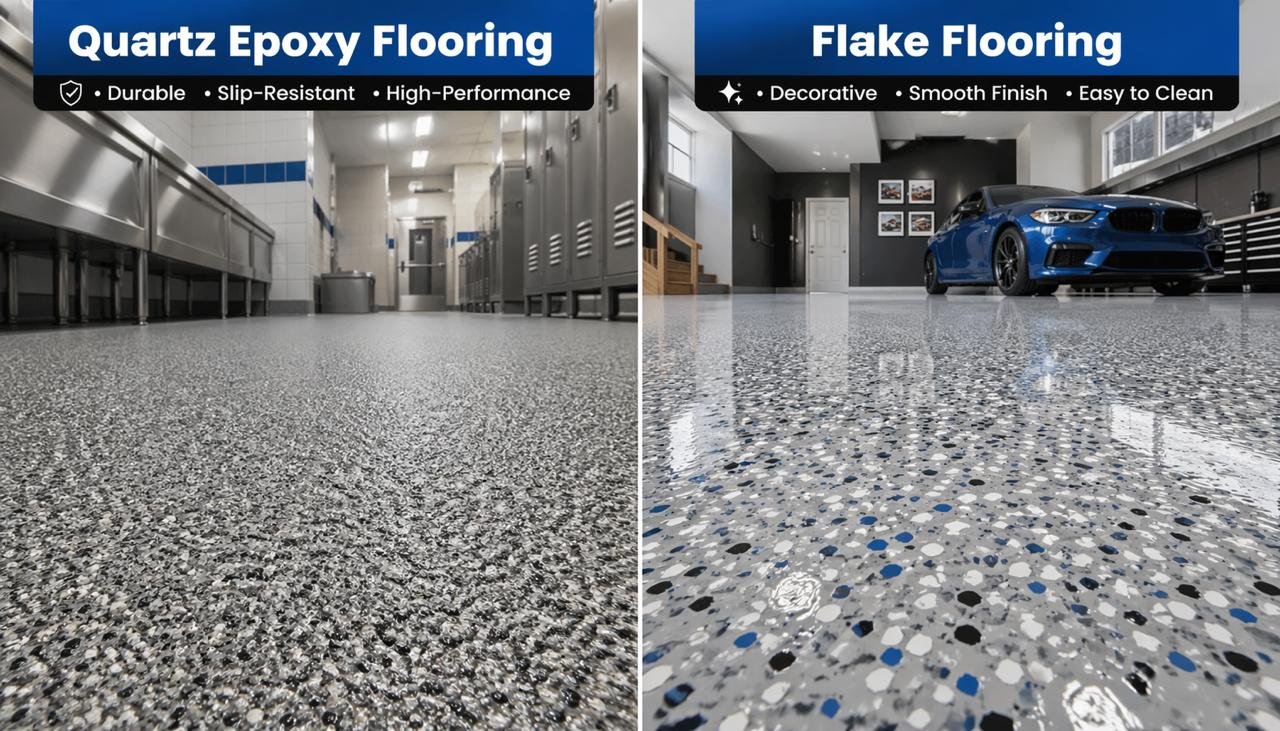
When choosing a durable, decorative floor coating, two systems often come up: quartz epoxy flooring and flake flooring. Both are popular in residential, commercial, and industrial environments, and both are built on epoxy or similar resin systems. At a glance, they may look similar—but their composition, performance, and ideal applications differ in important ways.
If you’re trying to decide which system is right for your project, understanding these differences can save you time, money, and maintenance headaches down the line.
Quartz epoxy flooring—often called a quartz broadcast system—combines epoxy resin with colored quartz granules. These granules are broadcast onto a base coat of epoxy and then sealed with a clear topcoat.
The result is a textured, highly durable surface that offers:
Because of these properties, quartz systems are widely used in:
The texture can be adjusted depending on how much quartz is broadcast and how it’s finished, making it versatile for both safety and design.
Flake flooring—also known as decorative chip flooring—uses vinyl or acrylic flakes instead of quartz. These flakes are also broadcast into an epoxy or polyaspartic base coat and sealed with a clear topcoat.
This system is best known for its decorative appeal, offering:
Flake flooring is commonly used in:
It strikes a balance between aesthetics and durability, making it a go-to option for spaces where appearance matters just as much as performance.
The most fundamental difference lies in the broadcast material:
Quartz is heavier and denser, which contributes to its superior durability. Flakes, on the other hand, are designed more for visual texture than structural strength.
Quartz epoxy systems are built for high-performance environments. They can withstand:
Flake flooring is still durable, but it’s generally better suited for moderate-use areas rather than extreme industrial settings.
If you’re outfitting a hospital or food processing facility, quartz is typically the better choice. For a garage or showroom, flakes are often more than sufficient.
Quartz flooring offers superior slip resistance due to its gritty texture. This makes it ideal for environments where safety is critical, especially in wet areas.
Flake flooring can be slip-resistant as well, but it usually requires additional additives in the topcoat to achieve the same level of traction.
Flake flooring clearly wins in terms of visual variety. It comes in a wide range of:
Quartz flooring is more limited in design but still offers a clean, professional look with subtle texture.
So the choice here depends on your goal:
Both systems are relatively easy to maintain, but quartz flooring has a slight edge in hygienic environments.
Its texture can be sealed to create a surface that:
Flake floors are also easy to clean, but their slightly smoother finish may show wear patterns over time in high-traffic areas.
Both systems involve similar installation steps:
However, quartz systems can be more labor-intensive due to:
This can increase installation time and cost slightly compared to flake systems.
In general:
That said, cost should always be evaluated against long-term performance. A quartz system may cost more upfront but last longer in demanding environments.
The right choice depends on how the space will be used.
Choose quartz epoxy flooring if you need:
Choose flake flooring if you want:
Both quartz epoxy flooring and flake flooring are excellent systems, but they serve different purposes. One prioritizes performance and safety, while the other leans toward design and versatility.
For suppliers and contractors like Xtreme Polishing Systems Australia, offering both systems allows them to cater to a wide range of projects—from industrial facilities to residential garages.
Understanding the strengths of each system ensures you choose a floor that not only looks good but also performs exactly as needed over time.